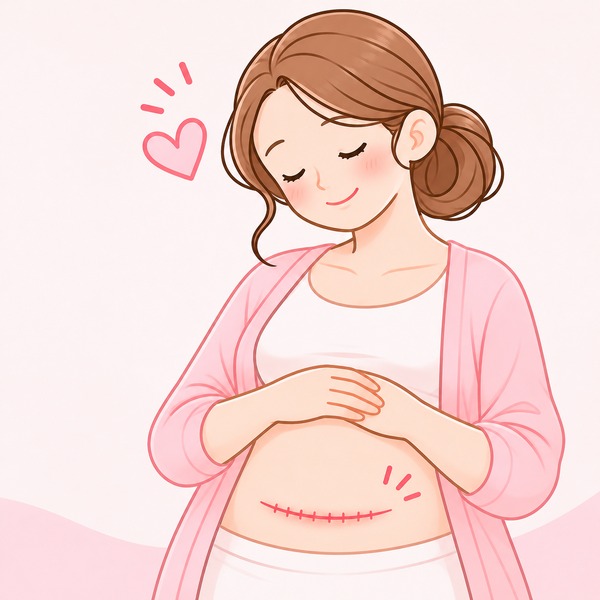
Many mothers worry about the scar left on their abdomen after a cesarean delivery. It may initially look red or raised and later feel itchy or firm. When will it fade, and when can you start using scar products? 💗
Key Facts About C-Section Scar Care
A C-section scar gradually fades over several months to a year or longer. Changes may continue for up to two years or more. Start scar treatments only after the incision has fully healed.
- Protect the incision and prevent infection during early recovery.
- Use silicone gel or sheets only on fully healed skin, after consulting your healthcare provider.
- Start gentle massage only when the wound is fully healed and your provider approves.
- Have persistent itching, pain or thickening assessed for hypertrophic scars or keloids.
- Seek immediate medical attention for fever of 100.4°F (38°C) or higher, pus, worsening pain or increasing warmth.
When does a C-section scar fade?
A C-section scar gradually fades over several months to a year or longer. Changes may continue for up to two years or more. Start scar treatments only after the incision has fully healed.
The surface incision may close within a few weeks, but deeper tissues and scar maturation take longer. Skin type, genetics, tension on the incision and infection can affect healing. A scar may fade without disappearing completely.

| Time after surgery | Typical changes |
|---|---|
| First 2 weeks | The incision begins healing; mild redness, swelling and tightness may occur. |
| 2 weeks–3 months | The scar may appear pink or red, itchy or firm. |
| 3–6 months | The scar may remain darker or raised as tissue changes. |
| 6–12 months and beyond | Color and thickness may gradually become less noticeable. |
These stages are approximate; recovery varies from person to person.
Scar care at each stage of recovery
Care should follow the condition of the incision rather than a fixed calendar.

1. First 2 weeks: Protect the incision
Follow your discharge instructions for dressings and showering. Keep the area clean and gently pat it dry. Wear loose clothing, avoid rubbing or picking scabs, and do not apply scar products to an unhealed wound.
2. After complete healing–3 months: Begin scar care
Once the skin is closed with no drainage or scabs, ask your obstetric provider about silicone products. Follow the product directions, avoid friction and stop use if irritation or a rash occurs.
3. 3–6 months: Monitor the scar
Observe changes in color, thickness and width. Gentle scar massage may be appropriate once fully healed and approved by your provider; you do not necessarily need to wait three months. Protect exposed scars from sunlight.
4. 6–12 months and beyond: Continue care
If redness, thickening, itching or pain persists, consult a dermatologist or plastic surgeon. Silicone products, corticosteroid injections or laser treatment may be considered depending on the scar.
When can you use silicone gel or sheets?
Silicone gel and sheets should be used only when the incision is completely healed, without open areas, drainage or scabs. If there are signs of inflammation or delayed healing, seek advice before using them.
| Feature | Silicone gel | Silicone sheets |
|---|---|---|
| Form | Applied to the skin | Adhesive sheet placed on skin |
| When to use | After complete healing | After complete healing |
| Purpose | May improve scar thickness and appearance | May improve scar thickness and appearance |
| Precautions | Follow application instructions | Check wear time and skin irritation |
Results vary. Consult your OB-GYN, dermatologist or plastic surgeon before choosing a product.
Hypertrophic scars and keloids
A raised, firm scar is not necessarily a keloid. A clinician can distinguish the two types.
Hypertrophic scar
Excess scar tissue remains within the original incision and may gradually improve.
Keloid
Scar tissue extends beyond the original wound and may persist, itch or hurt.
If the scar continues growing or causes discomfort, consult a dermatologist or plastic surgeon.
When to seek medical attention
Increasing redness or warmth, pus, foul-smelling drainage or fever may indicate an infection. Contact your obstetric care team immediately.

🚨 Warning signs
- Increasing redness or warmth around the incision.
- Worsening swelling or pain.
- Yellow or green pus.
- Foul-smelling drainage.
- Wound opening or persistent bleeding.
- Fever of 100.4°F (38°C) or higher or chills.
Seek immediate medical care for these symptoms. Heavy bleeding, difficulty breathing or reduced consciousness require emergency care. Persistent thickening, itching or pain after healing also warrants assessment.
Scar care checklist
Avoid trying to remove the scar quickly. Give your body time to heal.
✅ Do not apply scar products before complete healing.
✅ Do not pick scabs or rub the wound.
✅ Avoid excessive friction.
✅ Discuss silicone gel or sheets with your provider after healing.
✅ Consult a specialist for persistent thickening, itching or pain.
✅ Seek immediate care for signs of infection.
Frequently asked questions
Q. When will my C-section scar disappear?
It may fade over months to a year or longer, with changes continuing for up to two years or more. It may never disappear completely.
Q. When can I apply scar cream after a C-section?
Use scar products only after the incision is closed and free of drainage and scabs. Ask your provider when it is safe.
Q. Do silicone sheets help C-section scars?
They may help reduce thickness and improve appearance, but results vary. Use only on healed skin as directed.
Q. When can I massage my C-section scar?
Once the incision is fully healed and your provider approves. Avoid pressure or rubbing on an unhealed wound.
Q. Is an itchy, firm C-section scar normal?
Mild itching and firmness can occur during healing. Increasing symptoms or growth should be assessed.
Q. Is every raised C-section scar a keloid?
No. A hypertrophic scar stays within the original wound, while a keloid extends beyond it. A clinician can diagnose the difference.
Q. What if my C-section incision is leaking fluid or pus?
New or increasing drainage, pus, odor, warmth, pain or fever can indicate infection. Contact your obstetric care team promptly; do not squeeze the wound or apply scar products.
Your scar is part of your recovery after childbirth. Everyone heals at a different pace. Give your body the time and care it deserves. Enjoy your parenting journey with pregnancy&baby! 💗